
Fort Bend property tax relief comes from two places, and most homeowners only ever use one of them. You can reduce the taxable value through exemptions, or you can challenge the appraised value through a protest. In fact, doing both is where the real money is.
This page covers what each one is worth in Fort Bend County, when the deadlines fall, and what evidence actually changes an appraiser’s mind.
Two Ways to Lower Your Fort Bend Property Tax
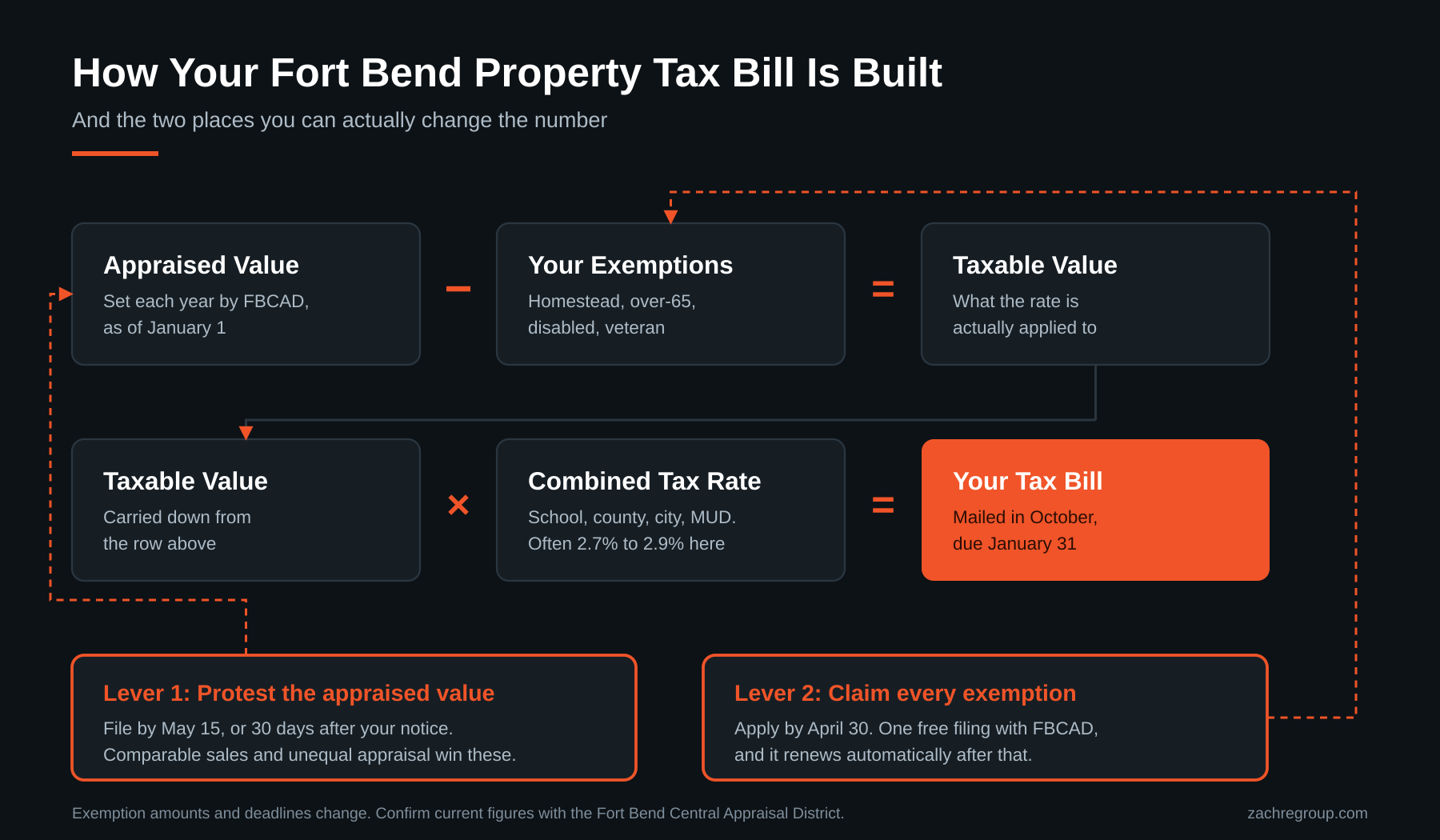
Your tax bill comes from a simple calculation. First, the Fort Bend Central Appraisal District, known as FBCAD, sets an appraised value. Then your exemptions come off that value. Finally, each taxing unit applies its rate to whatever is left.
Exemptions and protests attack different parts of that math. An exemption subtracts a fixed amount or percentage from your taxable value. A protest, by contrast, argues the appraised value itself is wrong. Because they are filed separately, on different deadlines and with different paperwork, neither one replaces the other.
Fort Bend Property Tax Relief Starts With Your Exemptions
Exemptions are the larger and easier win, and they are free to claim. The general residence homestead exemption is a one-time application. Once FBCAD approves it, it renews automatically for as long as the home stays your principal residence.
| Exemption | What it does | Who qualifies |
|---|---|---|
| General residence homestead | Removes $140,000 from school district taxable value for 2026 | Any owner using the home as a principal residence |
| Age 65 or older | Additional $60,000 school exemption, plus a school tax ceiling | Owners 65 or older by January 1 of the tax year |
| Disabled person | Additional school exemption plus a ceiling, similar to the over-65 benefit | Owners with a qualifying disability determination |
| Disabled veteran | Partial to full exemption depending on the rating | Veterans with a service-connected disability rating |
| Local option exemptions | Up to 20 percent of appraised value, set separately by each taxing unit | Varies by taxing unit and address |
The $140,000 figure is new. Texas voters approved Proposition 13 in November 2025, raising the school district homestead exemption from $100,000. Moreover, if you already have a homestead exemption on file, the increase applies without any action from you.
In addition, any taxing unit may adopt a local option homestead exemption of up to 20 percent of appraised value, with a floor of $5,000. The Texas Comptroller publishes the full list of exemptions and the statutes behind them.
How Much Is the Homestead Exemption Worth in Fort Bend County?
At a typical school district rate near 1 percent, a $140,000 exemption saves roughly $1,400 a year on the school portion alone. In addition, local option exemptions from the county and city stack on top of that.
Meanwhile, a homeowner 65 or older sees a combined $200,000 off school district taxable value. The savings scale accordingly.
Those are estimates, not quotes. Your actual number depends on which taxing units cover your address and what each of them charges. Indeed, two houses on opposite sides of the same street can land in different districts.
The Over-65 Exemption and the School Tax Ceiling
The ceiling is the benefit people misunderstand most. Once you qualify at 65, the school district portion of your bill is frozen at that year’s amount. As a result, it does not rise with your appraised value.
Two limits are worth knowing. First, the ceiling covers school taxes only, so county, city and MUD taxes can still climb. Second, it does not follow you automatically when you move. Texas does allow you to carry the benefit to a new homestead, but it transfers as a percentage rather than a dollar amount, and it requires its own paperwork.
That transfer is the single most common reason Fort Bend homeowners over 65 stay in a house that no longer fits them. Therefore it is worth understanding before you list, not after.
Fort Bend Property Tax Relief Through a Protest
Every Texas property owner can protest their appraised value each year. FBCAD mails notices of appraised value starting in April. The filing deadline is May 15, or 30 days after your notice is mailed, whichever falls later.
The process runs in two stages. First comes an informal conference with an FBCAD appraiser, which often settles the matter. If no agreement is reached, the case then goes to a formal hearing before the Appraisal Review Board in Rosenberg. You can file online, by mail, or in person.
One detail catches people out. A reduction won this year does not carry into next year. In other words, protesting is an annual exercise, not a one-time fix.
What Evidence Actually Moves an Appraised Value
Two arguments do the heavy lifting.
The first is comparable sales. If homes like yours sold for less than your appraised value, that is direct evidence the number is too high. The second is unequal appraisal, which compares your appraised value per square foot against similar properties. If yours sits above the median, then the district is treating you inconsistently.
Condition matters too, but only if it existed before January 1. That is the date all Texas appraisals are anchored to. For example, a roof replaced in March has no bearing on a January valuation.
Emotion and comparisons to your old tax bill carry no weight at a hearing. Clean, dated evidence, however, does.
The Fort Bend Property Tax Calendar
| Date | What happens |
|---|---|
| January 1 | Valuation date. Ownership, use and condition are fixed as of this day |
| April 30 | Deadline to apply for exemptions for the current tax year |
| April onward | FBCAD mails notices of appraised value |
| May 15 | Protest deadline, or 30 days after your notice, whichever is later |
| May to July | Informal conferences and Appraisal Review Board hearings |
| October | Tax bills are mailed by the county tax assessor collector |
| January 31 | Payment deadline. Amounts unpaid become delinquent February 1 |
If you missed the April 30 exemption deadline, late filing is often still possible for prior years. However, the rules differ by exemption type, so confirm your situation directly with FBCAD rather than assuming.
Why Fort Bend Property Tax Relief Is Worth More Here
Fort Bend has an unusual number of Municipal Utility Districts. Established districts levy roughly $0.17 to $0.36 per $100 of value. Newer districts still carrying construction debt can exceed $1.00.
Tax rates change every year. Every taxing unit sets its own rate annually, so the figures on this page show how a bill is built rather than what yours will be. Confirm the current rate for your specific parcel with Fort Bend Central Appraisal District before you rely on it.
Stack those on the school district, county and city rates, and total rates in unincorporated Fort Bend commonly run near 2.7 to 2.9 percent. As a result, every dollar of overvaluation costs a Fort Bend homeowner more than it would in a county with lower combined rates. A successful protest therefore returns more here.
Our Fort Bend MUD tax explainer breaks down how those districts work and how to check the rate for a specific address.
What This Page Does Not Cover
I am a real estate broker, not a tax attorney or a certified public accountant. This page explains how the process works. However, it is not tax or legal advice for your situation.
Exemption amounts, deadlines and local option percentages change, sometimes mid-year. Therefore, verify current figures with the Fort Bend Central Appraisal District before you act on anything here. Their office handles exemptions and protests, while the county tax assessor collector handles billing and payment. The two are not the same.
Frequently Asked Questions About Fort Bend Property Tax Relief
Do I have to reapply for my homestead exemption every year?
No. The general homestead exemption renews automatically as long as the home remains your principal residence. However, FBCAD may ask you to reverify periodically.
Does protesting my value affect my exemptions?
No. They are separate. Because exemptions are subtracted after the appraised value is settled, a successful protest and your exemptions compound.
Can I protest if I just bought the house?
Yes. Note that the 10 percent annual cap on appraised value increases applies to homesteaded property and resets when a property changes hands. As a result, a recent purchase can see a larger jump.
Do I need to hire someone to protest?
No. Homeowners can and do file their own protests. Still, a consultant is worth considering if assembling comparable sales and an equity analysis is not something you want to take on.
Where do I file?
Everything exemption and protest related goes to the Fort Bend Central Appraisal District, not to your mortgage company and not to the tax office.
Talk With a Local Fort Bend Broker
The strongest protest evidence is comparable sales data, and that is something I pull from the MLS every week. So if you are preparing a protest and want a read on what homes like yours actually sold for, I am happy to help you find the right comparables.
No pressure, no hype, and no promises I cannot keep.
Zach Emmanouil is a Broker Associate and Team Lead of ZACH RE GROUP at C.R. Realty, serving Fort Bend County and the greater Houston area. Reach him at 281-387-1535 or zach@zachregroup.com.