
Del Webb Fulshear is an age-restricted community built by PulteGroup’s Del Webb brand on FM 359 in Fulshear. Its recorded declaration sets the community up as housing for older adults, and the details matter more than the “55+” on the sign: who has to meet the age rule, who else may live in the home, how long younger guests may stay, and when an owner may lease.
This guide walks through those rules as the recorded documents state them, explains how the community sits inside the City of Fulshear, and covers what buyers, sellers, owners thinking about leasing and prospective tenants should check before they commit.
What Del Webb Fulshear Is
PulteGroup opened Del Webb Fulshear in October 2022 as its third Del Webb community in the Houston area. The community has been platted and built in sections, so new homes and resale homes can exist side by side, and construction can continue nearby while later sections are completed.
Del Webb designs its plans here around main-level living, but not every plan is strictly one story. Del Webb’s own Fulshear plan pages show at least one plan with an optional loft. Confirm the layout of the specific home, and judge features such as the primary suite location, shower entry, hallway widths and garage steps room by room rather than assuming them from the brand.
The homeowners association is Del Webb Fulshear Homeowners’ Association, Inc. Its governing documents start with the Declaration of Covenants, Conditions and Restrictions for Del Webb Fulshear, recorded with the Fort Bend County Clerk as File No. 2023008966, and a First Amendment recorded as File No. 2023101796. The declaration names Pulte Homes of Texas, L.P., doing business through its Del Webb brand, as the “declarant,” the developer that holds special rights under the documents. The association has also recorded a policy manual, rules and supplemental notices of dedicatory instruments.
The declaration originally applied to a tract of land described in its first exhibit. The declarant has since recorded notices of annexation, in 2023 and 2025, that bring additional described land under the same declaration. Which land is covered depends on those legal descriptions, not on the community name, so check that the title commitment for a specific lot lists the declaration among its restrictions.
The Age and Occupancy Rules
Federal fair housing law generally prohibits discrimination based on familial status, which covers households with children under 18. It exempts housing intended and operated for occupancy by persons 55 or older from that familial-status rule, but only if at least 80 percent of the occupied units have at least one occupant who is 55 or older, the community publishes and follows policies showing that intent, and it verifies occupancy through reliable surveys and affidavits. The Del Webb Fulshear declaration adds its own, more specific rules. In the recorded documents we reviewed, the declaration:
- States that the community is intended to provide housing primarily for persons 55 or older and is to be operated as an age-restricted community in compliance with state and federal law.
- Requires each occupied lot to be occupied by at least one person 55 or older, subject to a sales right the declaration reserves for the declarant.
- Reserves to the declarant the right to sell lots to buyers aged 50 through 55, provided those sales do not affect the community’s compliance with the state and federal laws for age-restricted communities.
- Defines an age-qualified occupant in two ways: a person 55 or older who occupies the lot, or a person 50 or older who owns and occupies the lot and was its original purchaser from the declarant. By its terms, the second alternative does not extend to someone who later buys the home on resale.
- Recognizes as residents other people 19 or older who occupy a lot with an age-qualified occupant. A person 19 or older who occupied the lot with an age-qualified occupant may continue as a resident after that occupant’s occupancy ends, but only while continuing, without interruption, to occupy the same lot.
- Bars anyone under 19 from staying overnight in a home for more than 90 days in any 12-month period.
- Directs the board to set policies and procedures to monitor and maintain the community’s age-restricted status.
Occupancy and ownership are separate questions. The provisions summarized above regulate who lives in a home. If you plan to buy a home you will not live in, buy one for a family member, or hold title differently from the people who will occupy it, have the declaration and the association’s current policies reviewed for how that arrangement fits before you sign a contract. Do not assume that because the federal test counts occupants, any particular ownership or leasing plan is allowed.
Caregivers deserve a specific question. A live-in caregiver may meet the declaration’s definition of a resident depending on age and circumstances. Where a disability is involved, federal fair housing rules also require reasonable accommodations in rules, policies and practices when they are necessary for equal use of a home. Put the question to the association in writing and get its answer in writing.
City Limits, Districts and Schools
Many homes with a Fulshear mailing address sit outside the city, in Fulshear’s extraterritorial jurisdiction. Del Webb Fulshear is different. In the City of Fulshear’s GIS data we reviewed, the mapped Del Webb subdivision area lies entirely inside the current city limits, and so does every parcel the City’s parcel layer identifies as Del Webb Fulshear, across all of the platted sections. That includes the residential lots, not just association-owned reserves, and those parcel records list the City of Fulshear as a taxing unit. Boundaries and records can change, so confirm the specific property rather than relying on the community name.
Utility districts are less uniform. In the same records, the residential lots list Fort Bend County MUD 245, while some reserves and road parcels in the earliest sections fall partly in MUD 174. Look up each property on the Fort Bend Central Appraisal District property search to see every taxing unit on that parcel, and confirm boundary questions with the City of Fulshear’s city limits and ETJ maps. The appraisal record shows who taxes the parcel. It does not, by itself, tell you which agency answers a 911 call.
City taxes, utility district taxes and the homestead and over-65 exemptions you qualify for all affect what you pay. Compare the taxing units on each house you are considering rather than relying on a rate quoted anywhere, including here.
City and appraisal records place this area in Lamar CISD. Confirm assigned campuses for an exact address with the Lamar CISD school locator.
Location and Getting Around
The community sits along FM 359, with FM 1093 nearby. Those state roads are how residents reach the rest of Fulshear and the wider highway network. Commute times change with the hour and with road construction, so drive your own routes at the times you would actually travel before you decide.
Amenities and Who Can Use Them
The association owns the amenity center site, and its recorded rules cover the amenity center, pools, spa and fitness areas, among other facilities. Del Webb describes indoor and outdoor pools, a fitness center, pickleball courts, a putting green, walking trails and an organized club and events calendar. Marketing descriptions can change, so ask which facilities are open, which are planned, and what hours apply.

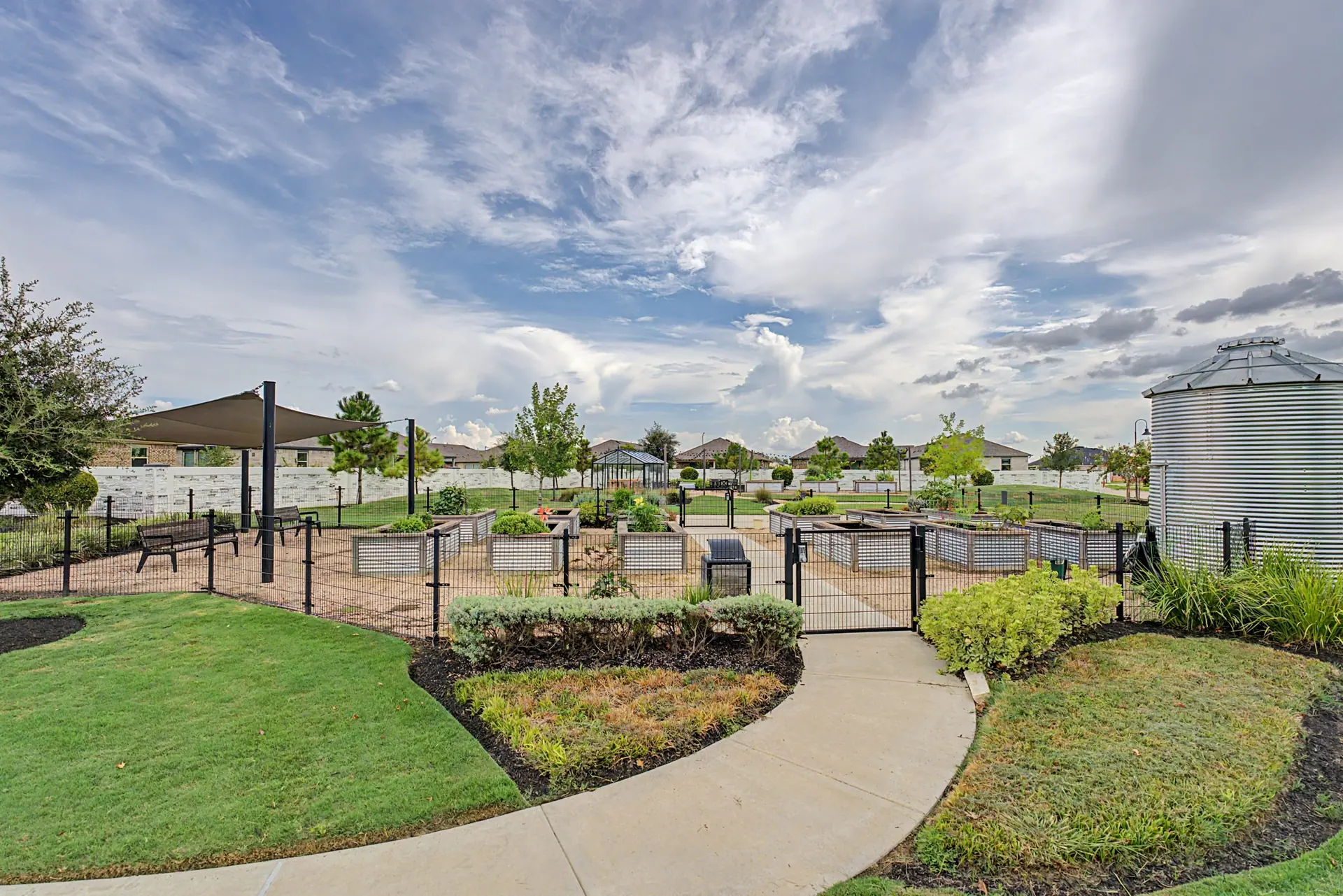
Access runs through activity cards issued by the association. Under the declaration and the rules we reviewed:
- Cards go to qualifying residents of a lot, with a limit per lot. Additional residents may obtain supplemental cards for a fee set by the board.
- Residents may bring a limited number of guests, who must stay with them. Guests and grandchildren under 19 must be accompanied and supervised, and some facilities restrict younger guests or set separate hours.
- When an owner leases the home, the right to use the facilities passes to the qualifying residents living there, and the owner’s own card is suspended for the lease term.
Rules and fees can change by board action, so read the current version before you rely on any detail.
HOA Obligations
Every owner is a member of the association and covenants to pay its assessments. The declaration allows several kinds of assessments, including base assessments for common expenses, assessments tied to particular neighborhoods or limited common areas, special assessments and charges for services to a specific lot. It also calls for a one-time contribution to the association when a home transfers, with some exceptions.
The association maintains the common area. Owners maintain their own lots and improvements, generally including the strip of public right-of-way between the lot and the street. The First Amendment requires wrought iron rear fencing on specified lots that back to a lake and makes those owners responsible for maintaining it. Exterior changes go through architectural review under the declaration and design guidelines.
Buying New Construction Here
The sales team in a model home represents the seller. If you want your own representation, decide before your first visit and ask the sales office how it handles agents. Texas also requires a written agreement between you and your agent before that agent shows you residential property, as TREC explains.
Hire your own inspector, and ask the seller in writing when and how your inspector may visit the site. Where construction progress and the seller’s access rules allow, common checkpoints are before the foundation pour, before drywall and before the final walkthrough. Read the warranty to learn what each coverage period includes and when each one ends, and schedule a follow-up inspection before the end of the period that covers the workmanship items you care about. New-home incentives are often tied to an affiliated lender or title company. That can still be a good deal, so compare the total cost against an outside lender and against comparable resale homes.
Buying a Resale Home
A resale lets you see exactly what you are buying and negotiate with an owner. Compare it against Del Webb’s current plans and inventory, if any, and use closed sales of genuinely similar homes to judge value.
Plan for the association paperwork. You can review the recorded declaration, amendments and policy manual early. The resale certificate is different: it is a property-specific report from the association covering items such as assessments, amounts owed on that property, known violations and fees associated with the transfer. Who orders and pays for it follows your contract and its HOA addendum. In the usual workflow the seller orders it after the option period ends. Processing takes time, rush service may cost extra, and your contract deadlines control. Do not expect it before you have an accepted offer.
Check drainage and flood history for the specific lot. Review the seller’s disclosure, look the address up on FEMA’s flood maps and get insurance quotes early. Lots that back to a lake or detention area deserve a closer look at grading and fencing obligations.
Selling a Home in Del Webb Fulshear
Buyers and their agents will ask early how the age and occupancy rules apply to them. Have the declaration, the First Amendment and the association’s policy manual ready to share, and expect questions about leasing and guests.
Buyers may also compare your home with new homes still being sold under the Del Webb brand, if any remain. A resale buyer aged 50 to 54 should know that the declaration’s 50-or-older alternative covers only an owner-occupant who was the original purchaser of the lot from the declarant. It does not make a resale buyer of that age age-qualified, so that buyer should confirm in writing how the household would meet the age rule before signing a contract. Price against genuinely comparable homes and present what your home actually offers, such as completed landscaping or upgrades already installed. The declaration also requires a seller to give the board written notice of a sale, so build that step into your timeline.
If you are considering selling, interview Zach as your listing agent and ask how he would price and present your specific home.
Owners Thinking About Leasing
The declaration allows leasing with conditions. In the version we reviewed, a home may be leased only in its entirety, subleasing or assigning a lease needs the board’s prior written approval, leases must be in writing, and the initial lease term must be at least six months unless the board gives prior written consent. The owner must give the board notice of the lease and a complete copy within 10 days of signing, and must make the governing documents available to the tenant. The board may adopt further leasing rules, and a lease may be terminated for violations of the governing documents. The declaration also provides that, until the end of the development period, owners may not amend the six-month provision to prohibit the leasing of lots that the declarant has authorized for rental to transient tenants and for terms shorter than six months. That provision does not show that any particular home has such an authorization, and it does not change the six-month minimum for other leases, so confirm the current rules with the association before relying on a shorter term.
The age and occupancy rules apply to the people living in the home, so a tenant household has to fit them too. While the home is leased, you keep paying assessments but lose your own use of the amenities. Check your mortgage terms and insurance as well, and remember Texas landlord notice requirements, including flood disclosures. Our guide to leasing your house in Fort Bend County covers the broader decision. If you want help weighing leasing against selling, interview Zach for that role and ask how he would approach your home.
If You Are Looking to Rent Here
Before you apply, confirm in writing that everyone in your household fits the community’s age and occupancy rules and the limits on younger overnight guests. Ask for a written lease of at least the minimum term the declaration sets, and ask the owner for the governing documents and current rules. Tenants who qualify as residents generally receive the amenity access that the leasing owner gives up, so ask how activity cards are issued to you.
Frequently Asked Questions About Del Webb Fulshear
Is Del Webb Fulshear age restricted?
Yes. Its recorded declaration sets it up as an age-restricted community, requiring each occupied home to have at least one occupant 55 or older, with limited exceptions the declaration describes.
Can someone under 55 live there?
Only in limited situations the declaration describes. An age-qualified occupant is either a person 55 or older who occupies the lot or a person 50 or older who owns and occupies the lot and was its original purchaser from the declarant; the second alternative does not cover later resale buyers. Other people 19 or older may live with an age-qualified occupant, and one who occupied the lot with that occupant may continue after that occupant’s occupancy ends, but only while continuing, without interruption, to occupy the same lot. Anyone under 19 may not stay overnight more than 90 days in a 12-month period. Confirm how the documents apply to your household in writing before you buy or lease.
Can I lease out a home in Del Webb Fulshear?
The declaration allows leasing of the whole home under a written lease with an initial term of at least six months, unless the board gives prior written consent, plus notice to the board. The tenant household must also meet the age and occupancy rules, and the board may adopt further leasing rules, so check the current rules before you sign a lease.
Is Del Webb Fulshear inside Fulshear city limits?
In the City of Fulshear’s GIS data we reviewed, the mapped subdivision area and every parcel the City identifies as Del Webb Fulshear, including residential lots in all platted sections, lie inside the city limits, and those parcel records list the City as a taxing unit. Confirm the exact property on the appraisal district record.
What is a resale certificate, and when does a buyer get one?
It is a property-specific report from the association covering assessments, amounts owed, known violations and transfer fees. Who orders and pays for it follows your contract. In the usual workflow the seller orders it after the option period ends, and contract deadlines control.
Talk With Zach About Del Webb Fulshear
Whether you are buying, selling or deciding whether to lease, start with a conversation about your specific situation. Interview Zach for the role you need: buyer’s agent, listing agent or advisor on a lease-versus-sell decision.
No pressure, no hype, and no promises I cannot keep.
ZACH R E GROUP
Zach Emmanouil
Broker Associate at C.R. Realty
281.387.1535
zach@zachregroup.com